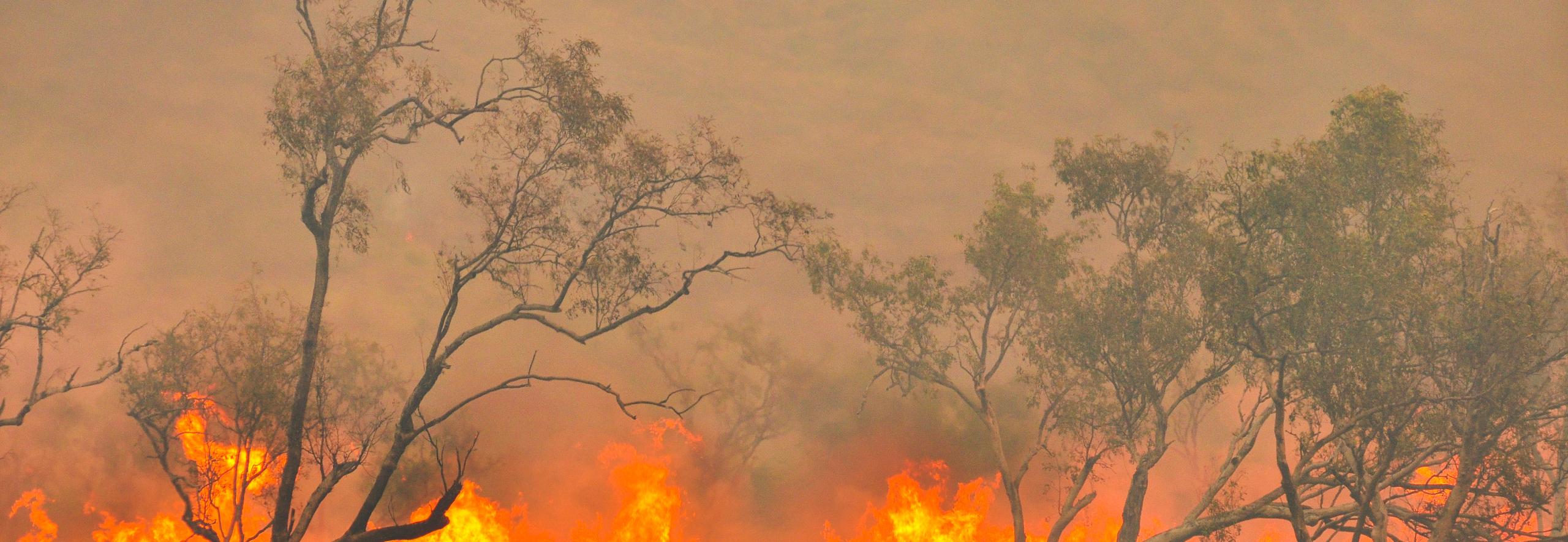
Bushfires have always been part of Australia’s landscape. However, catastrophic bushfires are increasingly threatening communities, livelihoods, and critical infrastructure all over the world. Between climate volatility and a rise in extreme weather events, it’s clear Australia faces a future of living with more intense and unpredictable bushfires. It’s vital that we work together across communities, industries, and governments to strengthen our resilience and ensure a safer environment for all.
The Australian National University (ANU) and its partners have developed the OzFuel-1 satellite payload to provide landscape flammability risk data at a continental scale to support effective planning, preparation, and response.
Over the past three years, ANU has made major investments in developing OzFuel-1, the first in a series of new and innovative spaceborne sensors. This sensor has been designed to be sensitive to leaf-level flammability traits in eucalypt trees, as well as being capable of detecting changes in the flammability traits of other vegetation fuels. With the data provided by the OzFuel-1 sensor, we can mitigate fire risks by knowing where the fuel is, how much there is, how dry it is, and what the risk is to neighbouring communities and critical infrastructure.
Once in space, the OzFuel-1 satellite payload will provide the nation with the most cost-effective way to measure the daily to weekly changes of bushfire risk over the whole of the Australian landmass, as well as on a global scale.
The experts driving the OzFuel Project combine world class expertise in remote sensing of bushfires, sensor development, and innovation. The OzFuel Project leverages advanced instrumentation technologies from astronomy, and key industry partnerships in space systems technology to develop the OzFuel-1 satellite payload and the Project as a whole.
The OzFuel-1 satellite payload will derive spatial, spectral, and radiometric resolutions tailored to the needs of vegetation and fire applications over the Australian mainland. The captured data will be made freely available to anyone involved in assessing bushfire risk, predicting fire behaviour, informing suppression efforts, planning prescribed burns, as well as to other users to make our communities more resilient.
Mission goals
Develop, test, and deploy a satellite that will monitor forest flammability, thereby protecting Australia from catastrophic bushfires and informing fire management and response operations
ANU team
- Associate Professor Marta Yebra
- Professor Rob Sharp
- Dr Nicolas Younes
- Dr Joice Mathew
Milestones
- The opto-mechanical design of the OzFuel-1 Short Wave Infrared telescope has been completed. Fabrication of the optical elements for the OzFuel telescope is underway with KiwiStar in New Zealand. The main elements are awaiting coating, and the final design of the telescope’s mounting structure is in fabrication.
- As a part of a CRC-P led by Canberra-based SME New Frontier Technologies (NFT), an experimental carbon fibre optical mounting system - designed to achieve Zero Coefficient of Thermal expansion (CTE) - has been fabricated based on OzFuel-1 specifications. This system, developed using carbon composite additive manufacturing by NFT, offers a strong, lightweight barrel assembly that maintains optical alignment across varying temperatures.
- The ANU laboratory test cryostat interface has been modified to integrate the cooled (80 K) SAPHIRA focal plane with the OzFuel opto-mechanical system. Laboratory prototype of the ANU ‘Rosella’ detector controller for Leonardo’s advanced shortwave infrared SAPHIRA electron avalanche photodiode (eAPD) arrays is completed through the iLAuNCH Trailblazer program, and this will be interfaced with the OzFuel-1 opto-mechanical system.
- The OzFuel team has been using an advanced end-to-end image simulator developed for satellite missions to examine what the images of the OzFuel-1 satellite payload would look like. The goal is to analyse and optimise the sensor's performance to detect changes in fuel flammability over a range of simulated and real scenarios.
- The OzFuel team will continue to assess the data collected in the field to verify and validate the sensor requirements. The teal will also use an end-to-end simulator to examine what OzFuel will capture from space. These simulations will help verify sensor designs and design the data products for the mission.
Breaking news
Bushfire Research Centre of Excellence annual report
28 Oct 2025As bushfires grow more frequent and complex, the need for integrated, science-driven solutions has never been greater. This year’s report showcases how the Bushfire Research Centre of Excellence, through partnerships across government, emergency services, research, and industry, is demonstrating and developing the technologies that will underpin a more intelligent and connected fire management system for Australia.