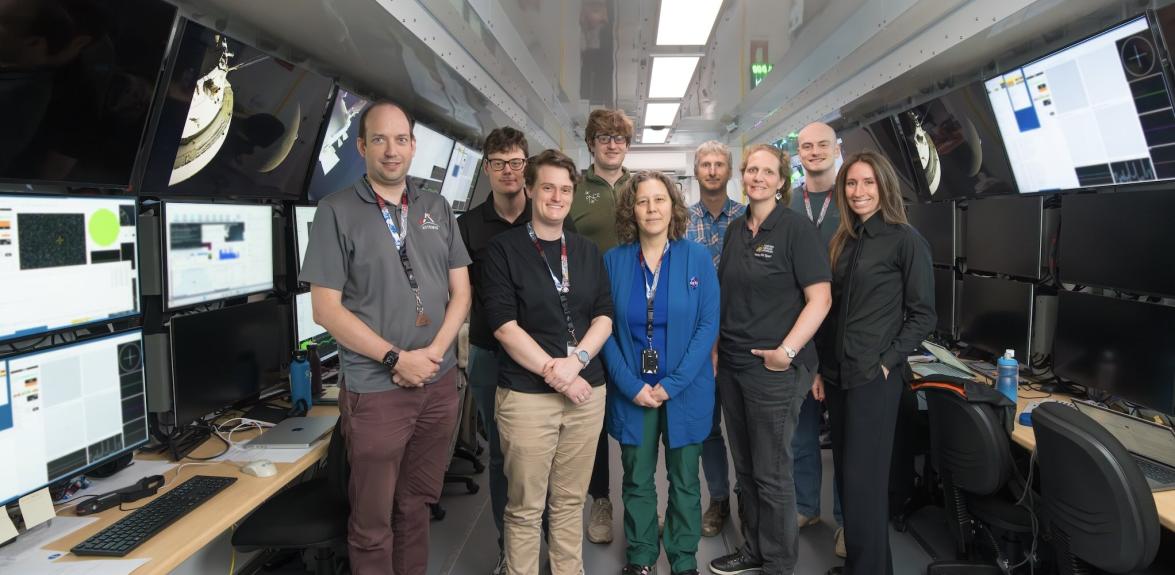
On April 1 the Orion spacecraft launched on top of the SLS (Space Launch System) rocket to orbit the moon as part of NASA - National Aeronautics and Space Administration’s Artemis II mission. Waiting patiently at The Australian National University Mt Stromlo Campus, was Professor Francis Bennet and his team - Dr Elisa Jager, Dr Doris Grosse, Dr Michael Copeland, Ian Price, along with NASA personnel Dr Terra Hardwick (NASA), Dr Sarah Tedder (NASA), Dr Kristoffer Comiskey Olsen (NASA), and Dr Peter William Simon (NASA). All were poised ready for their opportunity to demonstrate the lunar communications the ANU Quantum Optical Ground Station (QOGS) to demonstrate optical communications from Australia.
Three optical ground stations were used during the mission: NASA’s White Sands Test Facility in Las Cruces, New Mexico; NASA’s Jet Propulsion Laboratory's Table Mountain Facility near Wrightwood, California, which both were used for high-bandwidth laser communications, and the ANU Quantum Optical Ground Station (QOGS) which focused on testing and demonstrating the facility.
The QOGS received the highest possible data rate supported by Orion’s optical terminal at 260 Mbps at a range of 343,000 km on April 5, and the longest-range optical link of the mission, at just over 400,000 kilometers on April 6. In over 15.5 hours of laser link time QOGS downlinked 43 GB of data, streaming internal and external camera views of the mission back to NASA’s Mission Control Center in Houston and out to the world. The QOGS also demonstrated the successful 4k video stream from the spacecraft on April 8.
On the final day of the mission, the QOGS achieved a long fault-free run at the highest possible data rate of 260 Mbps.
Having a QOGS located in the Southern Hemisphere extended the opportunity to utilise optical communications during the mission. This was due to geographic diversity, which helped circumnavigate weather and clouds that would interfere with optical links while providing longer views of Orion each day, as the Moon was also located in the southern hemisphere throughout the mission. This enabled Orion and optical ground stations longer contacts and increased high quality video streaming, which complemented the crucial science and mission data downloads through the US stations in California and New Mexico. The ANU facility and personnel performed without equipment failure, despite the system’s novel design, which was developed using commercial off-the-shelf parts.
ANU were supported in the lead up to and throughout the mission by NASA personnel from the NASA Glenn Research Center in Cleveland and NASA Goddard Space Flight Center in Greenbelt, Maryland. Partnering with these technical experts enabled ANU to accelerate the adoption and implementation of highly complex and experimental pieces of optical equipment to support the mission. This performance and collaboration are paving the way towards future missions equipped with optical communications.
Photos: Nic Vevers ANU Media
Front row: Prof Francis Bennet (ANU), Dr Elisa Jager (ANU), Dr Sarah Tedder (NASA), Dr Doris Grosse (ANU), Dr Terra Hardwick (NASA)
Back row: Dr Michael Copeland (ANU), Dr Kristoffer Olsen (NASA), Ian Price (ANU), Dr Peter (William) Simon (NASA)